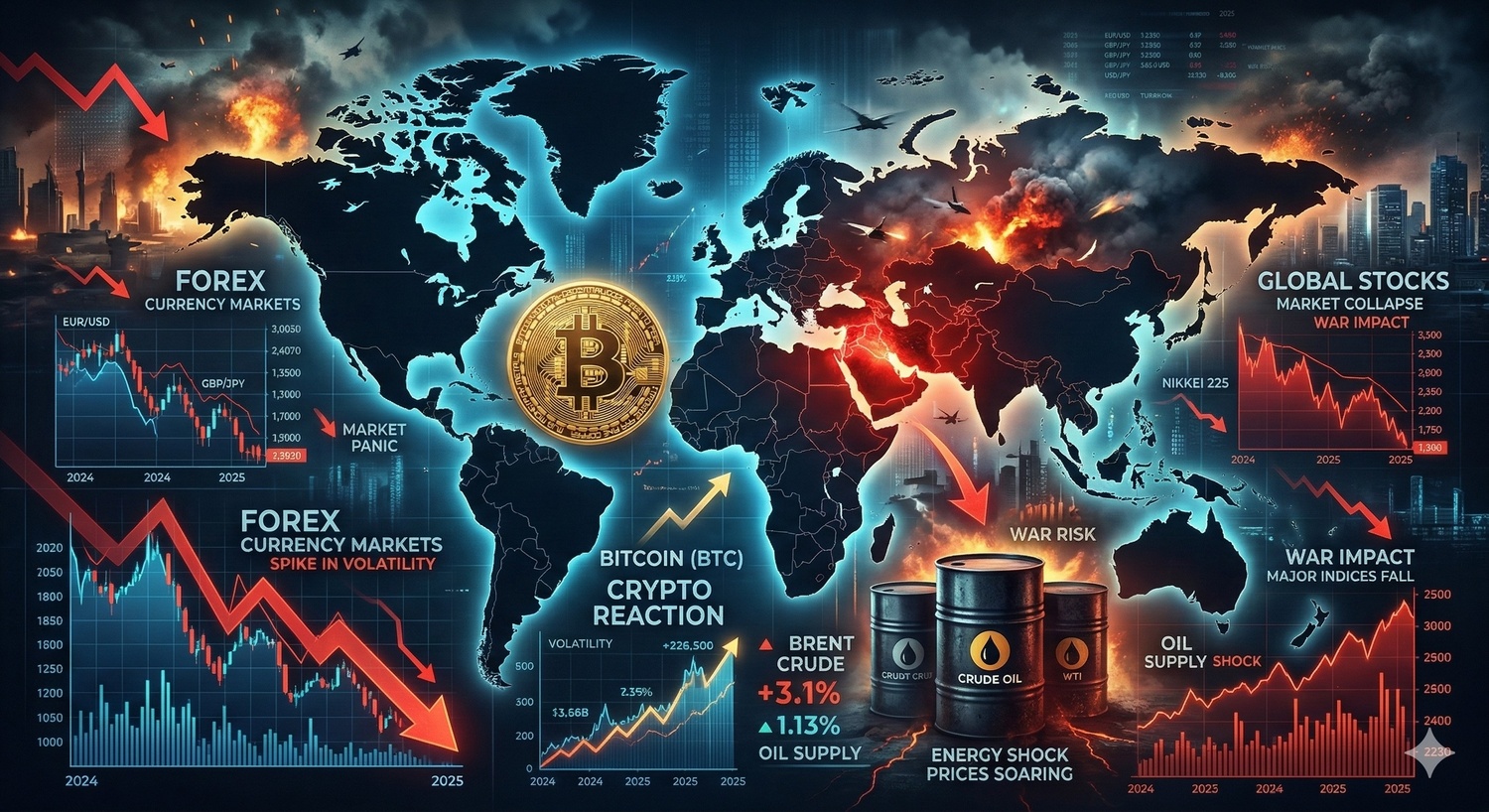
Global financial markets react instantly to geopolitical tensions. The recent escalation between Iran and the United States has triggered volatility across forex, cryptocurrency, commodities, and stock markets worldwide. Investors are shifting capital, oil prices are rising, and markets are becoming highly unpredictable.
In this article, we analyze how the Iran–USA conflict influences financial markets and what traders should watch closely
.
1. Impact on Forex Market
The forex market is extremely sensitive to geopolitical tensions because currencies reflect economic stability and investor confidence.
Safe-Haven Currencies Rise
During conflicts, investors usually move money into safe-haven currencies such as:
- US Dollar (USD)
- Japanese Yen (JPY)
- Swiss Franc (CHF)
This happens because these currencies are considered stable during global uncertainty. Analysts note that escalating tensions in the Middle East have increased demand for these currencies as investors seek safety.
Oil-Linked Currencies Become Volatile
Countries whose economies depend heavily on oil exports can see currency fluctuations.
Currencies affected include:
- Canadian Dollar (CAD)
- Norwegian Krone (NOK)
- Gulf region currencies
Because Iran is located near the Strait of Hormuz, a route that carries a large portion of the world’s oil supply, any disruption can strongly affect forex markets.
Forex Trading Opportunities
For traders, geopolitical tensions often create:
- Increased volatility
- Strong trending markets
- Short-term trading opportunities
Pairs like USDJPY, USDCAD, and XAUUSD usually react quickly during such events.
2. Impact on Cryptocurrency Market
Cryptocurrency markets behave differently depending on investor sentiment.
Crypto Often Drops During Global Fear
When war risks increase, investors often sell risky assets such as crypto.
During the recent escalation:
- Bitcoin dropped below $67,000
- The crypto market lost billions in value
- Many traders moved funds into gold and other safer assets
This happens because crypto is still seen as a risk asset, similar to tech stocks.
Volatility Creates Trading Opportunities
However, crypto markets also recover quickly because they trade 24/7.
Major events like military strikes triggered:
- Rapid price swings
- Massive liquidations
- Large trading volumes
For short-term traders, geopolitical news can create strong momentum moves in BTC, ETH, and altcoins.
3. Impact on Global Stock Markets
Stock markets usually react negatively to geopolitical conflict due to uncertainty.
Market Sell-Offs and Volatility
Many global stock markets decline during major geopolitical tensions as investors reduce risk exposure.
Rising oil prices and trade disruptions are already causing stock market volatility worldwide.
Some Sectors Benefit
Not all stocks fall during war. Some industries actually rise:
Industries that benefit from conflict
- Defense companies
- Energy companies
- Oil & gas producers
Energy stocks have surged as oil prices rise due to fears of supply disruptions in the Middle East.
Global Economic Risks
Economists warn that prolonged conflict could create:
- Global inflation
- Supply chain disruptions
- Slower economic growth
These factors may influence central bank policies and interest rates.
4. Oil Prices – The Biggest Market Driver
Oil is the most sensitive asset during Middle East conflicts.
Recent tensions have already caused:
- Oil prices to surge sharply
- Shipping disruptions in the Strait of Hormuz
- Supply fears across global markets
Analysts warn that oil could exceed $100–$150 per barrel if disruptions worsen.
Higher oil prices lead to:
- Inflation
- Higher transportation costs
- Slower global economic growth
5. Key Market Trends Traders Should Watch
If the Iran–USA conflict continues, traders should monitor:
Forex
- USD strength
- JPY and CHF demand
- Oil-linked currencies volatility
Crypto
- Bitcoin reaction to geopolitical news
- Large liquidations
- Risk sentiment in global markets
Stock Market
- Defense sector growth
- Energy sector rally
- Technology sector volatility
Commodities
- Oil price spikes
- Gold safe-haven demand
Conclusion
The Iran–USA conflict has already started influencing global financial markets. Forex markets are seeing strong demand for safe-haven currencies, cryptocurrency markets are experiencing volatility, and stock markets are reacting to rising energy prices and geopolitical uncertainty.
For traders and investors, geopolitical events like this create both risk and opportunity. Understanding how these events affect different markets can help traders make better decisions and manage risk effectively.
No responses yet